
Menu
Handheld Gaming Console Based on Raspberry Pi Zero 2W
Portable Raspberry Pi gaming platform with audio, display, battery management, and haptic feedback.
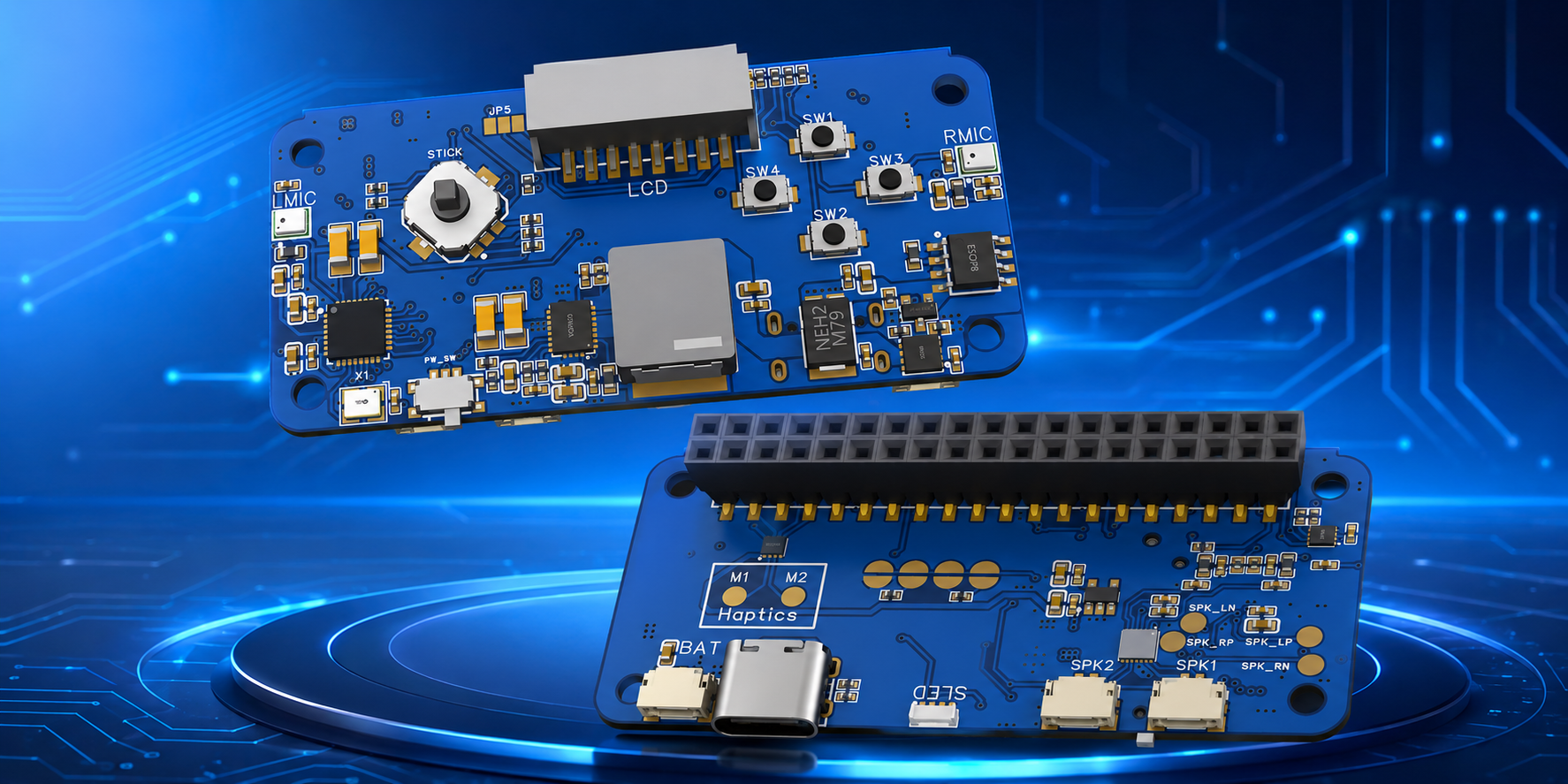
Designed a custom handheld gaming console based on the Raspberry Pi Zero 2 W, integrating audio, display, power management, user input, and haptic feedback into a compact battery-powered platform. The project involved complete hardware design from schematic capture through PCB layout, prototype validation, and production-ready manufacturing deliverables.
The system features a complete digital audio subsystem built around the WM8960 audio codec connected to the Raspberry Pi via the I2S interface. Dual MEMS microphones enable audio capture, while stereo Class-D amplifiers drive external speakers to provide high-quality audio playback. Careful consideration was given to audio signal integrity, grounding, and mixed-signal PCB layout to ensure reliable performance.
User interaction is provided through an analog joystick, multiple debounced push buttons, and a haptic feedback motor driven by an H-bridge circuit, creating an engaging handheld gaming experience. A WS2812B RGB LED provides visual system status indication and user feedback.
The graphical interface is displayed on a 3.5-inch TFT screen driven by the ILI9486 display controller over an SPI interface. The display subsystem was integrated alongside the audio, power, and user-input circuitry while maintaining a compact board footprint suitable for a portable device.
A key aspect of the design was the power architecture. The device operates from a rechargeable lithium-ion battery and incorporates a dedicated charging circuit, battery fuel gauging, and intelligent power-path management. A MAX17048 fuel gauge communicates with the Raspberry Pi over I2C, providing accurate battery state-of-charge information for monitoring and user feedback. The power-path circuitry was designed to allow seamless operation from either the battery or a USB-C power source, enabling uninterrupted use while charging. A high-efficiency TPS61088 boost converter generates stable system power rails for the Raspberry Pi and peripheral devices across the full battery operating range.
Beyond hardware design, complete manufacturing documentation was prepared, including fabrication files, assembly documentation, and bill of materials. Prototype boards were fabricated and assembled in-house for hardware bring-up, debugging, validation, and design verification before the final production package was delivered to the client.